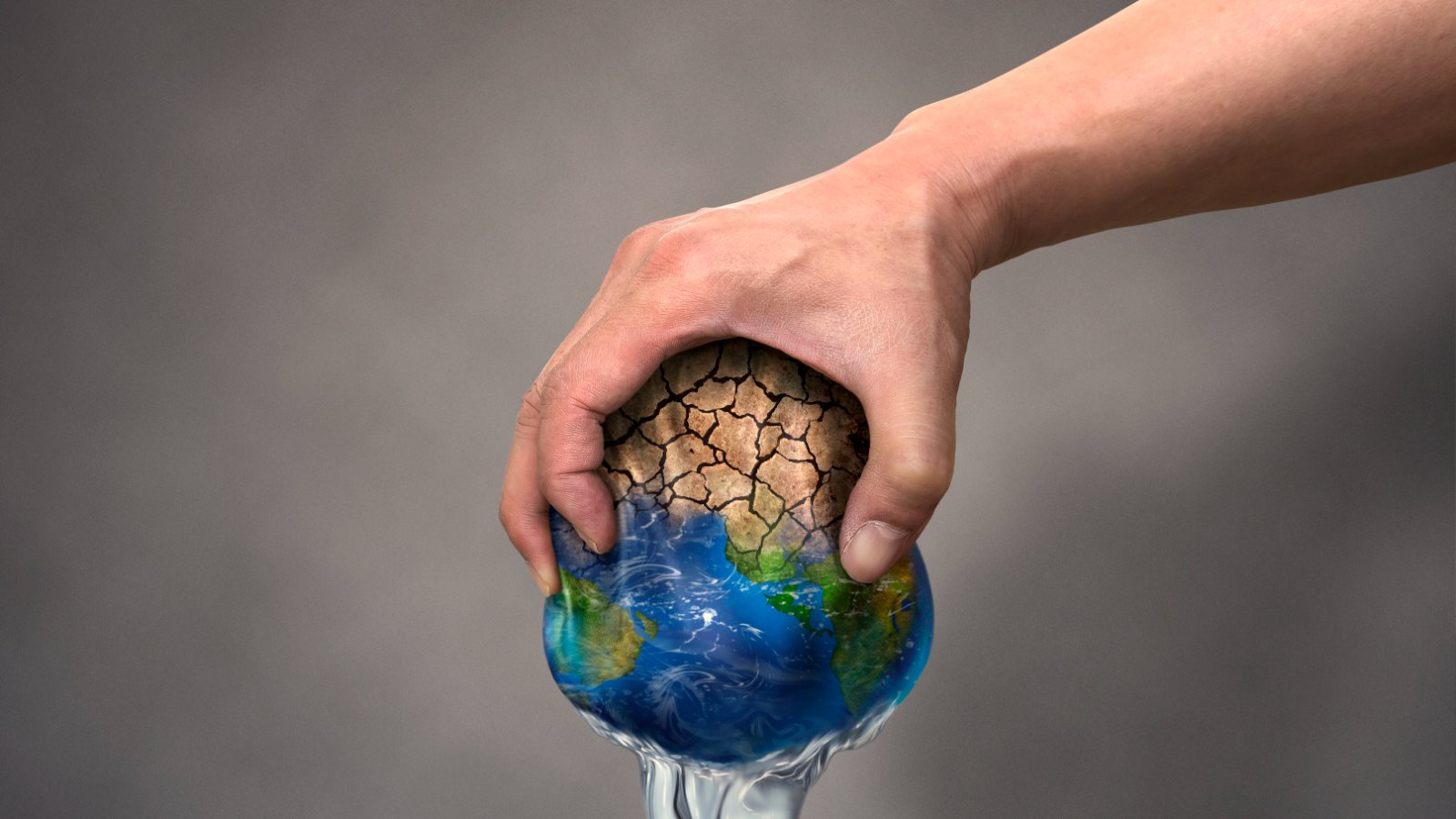
Summer 2026 will go down as one of the driest ever recorded in France. By 14 August, more than 90 mainland départements were subject to drought restrictions, and a large majority had moved to the highest alert level, that of crisis. In early August, every mainland département was on at least the first watch level.
The images became familiar as the weeks went by: household water use restricted, rivers and groundwater running dry, farmers forced to limit irrigation. A rainfall deficit in place since May, combined with heatwaves that followed one another into August, made 2026 a summer of near-permanent water stress, more severe still than 2022, until then regarded as a record.
A crisis playing out catchment by catchment, not just département by département
What sets 2026 apart is how finely the crisis now reads. The national restrictions map does not tell the whole story: a département classified at the maximum level is not necessarily affected across its entire territory. Orders are issued catchment by catchment, sometimes municipality by municipality, according to the real state of groundwater and watercourses. Some areas saw their restriction level tightened week after week as the resource deteriorated, with no significant return of rain to reverse the trend.
The consequences go well beyond everyday comfort. Agriculture is on the front line, with irrigation bans affecting arable crops, grassland and at times market gardening. Livestock farming also suffers from the heatwaves that accompany drought. Some municipalities had to be supplied with drinking water by tanker, a situation that is a reminder that access to water, long taken for granted in France, is no longer guaranteed everywhere or at all times.
The drought also fed an exceptional wildfire season. According to the European Forest Fire Information System (Effis), more than 90,000 hectares of vegetation had already burned in mainland France and Corsica by mid-August, a level unseen in twenty years at that point in the year. Gironde, Drôme, Var, Pyrénées-Orientales and even Côtes-d'Armor, previously less exposed, were all affected, with mass evacuations in places. Parched vegetation, soils with no moisture reserve, persistent heat: the same conditions that trigger water restrictions feed the fire risk directly.
And in your property?
Thirty minutes to estimate your savings potential. No commitment.
A phenomenon that reaches beyond our borders
France is not an isolated case. The Mediterranean basin is among the regions of the world where warming most clearly goes hand in hand with a scarcer water supply, and several of its neighbours have had comparable summers in recent years, with the same symptoms: low groundwater, usage restrictions, fires. Water stress is therefore not a national meteorological accident, it is a shared underlying trend, and the summer of 2026 belongs to it.
That changes how the problem should be framed. If this were an exceptional summer, emergency measures would suffice. If it is a trajectory, then the question becomes one of everyday uses, the ones repeated everywhere and every day, regardless of any prefectural order.
What can still be done, and what is beyond our control
Faced with the emergency, the levers available to public authorities remain limited to the most visible uses, the ones easiest to regulate by decree: garden watering, filling pools, washing cars, agricultural irrigation. These measures are necessary, but on their own they are not enough to establish more frugal management of the resource over the long term, once the crisis has passed.
In some places, access to water is restricted and limited. And the largest share of domestic consumption is the shower: in France, 60 litres on average, repeated every day, in almost every household, and the same holds across every country where a daily shower is the norm. Unlike garden watering, it is not something you can ban by decree. It is a private, daily act, and above all an invisible one: nobody sees the flow rate or the volume running while they shower.
Episodes like 2026 are no longer isolated accidents. Water stress has been multiplying and intensifying for several years, and nothing today suggests that trajectory will reverse. The question is therefore no longer only how to manage the summer emergency, but how to establish more frugal consumption habits over time, including for the uses no decree can reach.
Make it visible, rather than impose limits
This is precisely what Molleau has been working on since 2022, with the Molleaumètre, a device that makes shower water use visible in real time. In the pilot run with Hénéo (RIVP group, Résidence Relais d'Italie, Paris), hot water use per shower fell by 23% on average, with no habituation effect over the monitoring period. The average volume of a shower goes from 46 L in the baseline phase to 35 L once the device is active.
Further proof that between constraint and going without, there is a third way: show people what is happening, and let them decide. What remains is to put a figure on it for your own case, and the savings calculator gives a first estimate in a few minutes.
Sources: French prefectural water restriction orders (Propluvia, situation as of 14 August 2026); Météo-France rainfall records (July 2026); European Forest Fire Information System (Effis), mid-August 2026 assessment; Molleau x Hénéo pilot, RIVP group, Résidence Relais d'Italie, Paris: 28 homes equipped, 3,140 showers analysed from November 2025 to June 2026, 23% less hot water per shower on average.